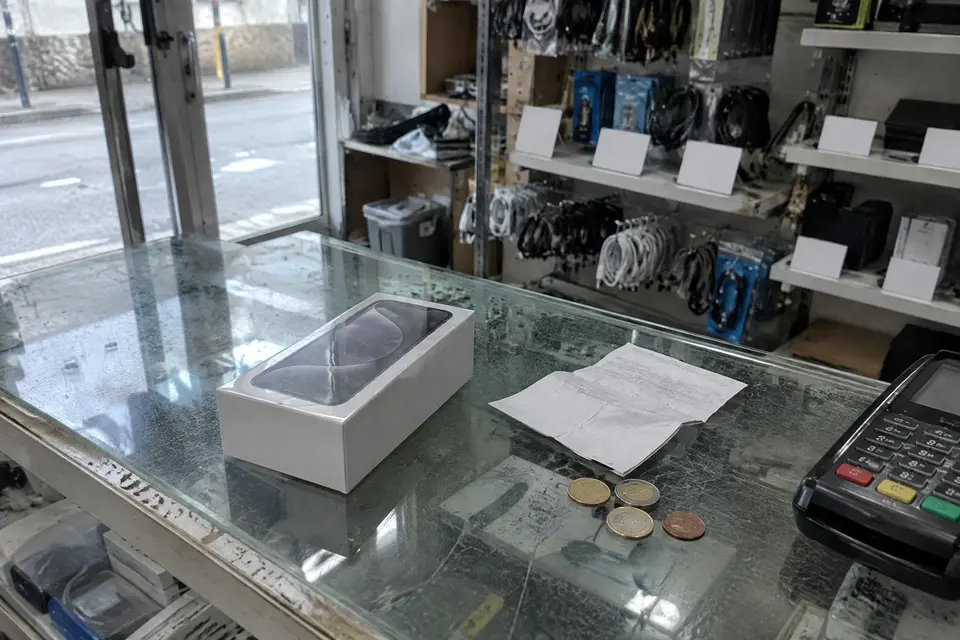
Buying an iPhone in Andorra: savings and warranty

Andorra doesn't publish tech employment figures on their own. This page gathers what is official.
No guides published in this section yet.
Andorra doesn't publish tech sector pay on its own. The average pay across all employees was €2,766.11 a month in June 2026. To work here you need an authorisation subject to a quota, with 702 places for employees and 198 for cross-border workers.
tec.ad editorial teamHow we reviewSources
Andorra has a small job market, and tech doesn't appear as a sector of its own in its statistics. The Department of Statistics doesn't publish ICT employment separately. The CASS (Andorra's social security) doesn't give an average IT salary either.
What you can see is who hires technical profiles. Banks and insurers have systems, data and cybersecurity teams. Andorra Telecom, the public operator, runs the country's fibre and mobile network. There are small consultancies and software houses, and a group of young startups.
ACTINN, the sector association, says it has more than 90 members. The public administration also hires for its digital transformation plan.
If you want to know who is who, the Andorra tech ecosystem page sorts out public bodies, startups, coworking spaces and training centres.
People thinking about a tech job in Andorra usually arrive with one of four questions: who is hiring, what it pays, what paperwork is needed, or whether they can keep working for their company abroad.
If you're going to work from a shared space, the coworking guide compares the ones there are and what each includes. And if what you want is to set up your own company, start with the tech business page.
Every month the CASS publishes average pay by sector. It works it out by dividing the total wage bill by the number of employees paid that month. There's no line for IT or for telecoms on their own.
The closest is sector I, which groups transport, storage and communications. In June 2026 it had 1,520 employees and an average of €3,046.38 a month. The national average was €2,766.11. The financial system came in at €4,620.92, and many systems profiles work inside a bank.
Bear in mind this is a gross monthly average. It doesn't distinguish between a support technician and a project manager. The minimum wage rises to €1,568.66 a month from 1 July 2026, for 40 hours a week.
To compare offers, always ask for the gross monthly figure and how many payments there are in a year.
The deductions taken off each month are set out in the tax and contributions section below.
To work in Andorra you need an immigration authorisation, unless you hold Andorran nationality. Each type has a quota that the Andorran Government (Govern) sets by decree.
First you need the signed offer. For A.1 and I.1 permits the company files the application on e-tràmits, not you. Ask at the interview whether they have hired people from abroad before and how long the paperwork took. It means no surprises over your start date.
seguros.ad explains the residence paperwork and the health insurance you'll be asked for. Here we stick to the tech side.
If you spend more than 183 days a year in Andorra, or your centre of economic interests is here, you're tax resident. You then pay Andorran income tax (IRPF).
The general rate is 10%. Between €24,000 and €40,000 of income, a relief of up to €800 brings the effective rate down to 5%. With employment income below €24,000 you don't have to file a return. The return is filed from 1 April to 30 September of the following year.
For the CASS, employees pay 6.5% of their salary and the employer 15.5%. If you're self-employed on the 100% base, the contribution is €587.95 a month.
If you live in Spain or France and work here, each country's double taxation agreement decides where your salary is taxed. Check your own case before you sign, because it depends on where you live and how many days you work on each side.
Since December 2022 Andorran employment law has covered remote work. Any contract can be done remotely, the agreement must be in writing and the employer covers the costs. It also recognises the right to disconnect outside working hours.
Most questions come from a different case. You live in Andorra and your company is in Madrid, Barcelona or Toulouse. The digital nomad residence (D.3), described above, is the permit built for it. Where you pay tax follows the residence rules in the previous section.
The tech vacancies we find in public sources are in the jobs section. To search on your own, the directory lists companies and startups with their websites.
If you would rather not work from home, check the coworking spaces in the coworking guide. If you need training, the Universitat d'Andorra and vocational training offer computing courses, listed in the directory. Sector meetups are in events.
And if you want to set up your own tech company, start with the guide to a tech business in Andorra.
No. The CASS publishes average pay by sector, and IT doesn't appear on its own. The closest is sector I, which includes communications, with an average of €3,046.38 in June 2026.
Yes, with the cross-border work authorisation, which the employer applies for. Decret 388/2026 sets aside 198 places for cross-border workers. If you stay where you live and work from there for an Andorran company, it's the I.1, work without residence.
The general rate is 10%. Between €24,000 and €40,000 of income, the effective rate comes down to 5%. With employment income below €24,000 you don't have to file a return.
6.5% of your gross salary. The employer adds another 15.5%, which doesn't come out of your payslip.
Yes. That's what the digital nomad residence (D.3) is for. It requires sickness and disability insurance and sufficient financial means, although no published regulation sets the amount.


